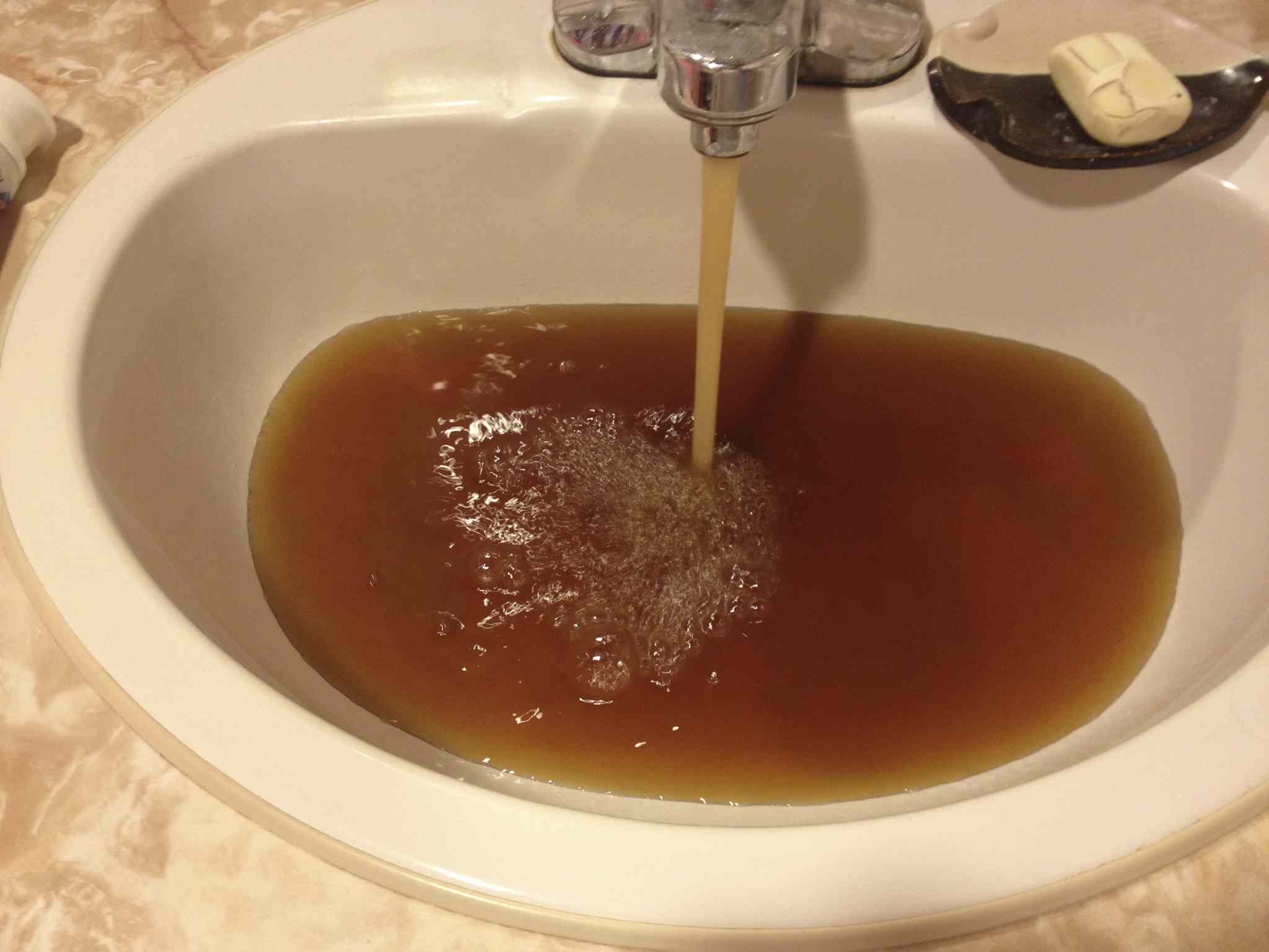
It’s hard to talk about infrastructure investment, but here’s one story. The New York Times reports that a family in Compton struggles with brown tap water:
For more than a year, discolored water has regularly gushed from faucets in the family’s bathroom and kitchen, as in hundreds of other households here in Willowbrook, Calif., an unincorporated community near Compton in South Los Angeles.
The brown water, provided by the Sativa Los Angeles County Water District, first drew public outrage and local news media attention last year when customers began protesting over unexplained stomach pains and skin so itchy it had scarred from the scratching.
The Crisis Lurking in Californians’ Taps: How 1,000 Water Systems May Be at Risk, New York Times, July 24, 2019
It’s a crisis! Who could have seen this coming? Who could have predicted such an unlikely event?
I don’t know, maybe, um, every single civil engineer on earth? They’ve been screaming about this for a generation or more. Weren’t you listening?
We were horrified and outraged about the lead levels in Flint, Michigan. And that’s a reasonable reaction. Flint is a theatrical disaster with mustache-twirling bad guys and sympathetic victims. And the lead problem there is being addressed, which is good. But don’t get too comfortable. There are many more cities and towns with high lead levels that aren’t getting the same attention.
And the people who really caused the problem are walking away scot-free. (This is a theme for us.) We usually won’t hold them responsible because we ignore the past. Instead, we attack the last wrong choice we can see, barely blinking at the earlier stuff. Americans aren’t big on history.
Go to the Wikipedia page for the Flint water crisis (and yes, there is one). It starts with “The Flint water crisis began in 2014…,” which is almost entirely wrong. Generations of city planners and managers knew they had miles of lead water pipes buried under their city. The crisis started when they decided that the risk of leaving the lead pipes in place was less than the cost of replacing them. Sure, the precipitating event for was in 2014 when they switched water supplies. But the (literal) groundwork was laid during the decades before.
Infrastructure is about as unsexy as you can get. It’s easy to build, but hard to keep it up. And it’s critical stuff. Just think about how much we depend on underground runoff and sewage and water and wiring. But we bury it in the dirt, then we drop large, hard-to-move buildings and busy roads on top of it all. Give it a century or two to marinate as engineers explain to us, over and over, that we need to maintain that stuff or it goes bad. Stuff begins to break.
The economics are easy, ‘stitch in time’ calculations. Paying five dollars now, they tell us, will save our kids five hundred dollars later. We ignore that advice because maintenance is boring and expensive. Why pay that when we need all that other stuff right now! As our underground toys eventually break, we dig up just enough to stop the worst leaks. We’re done. We move on, closing our eyes, hoping the next problem will hit someone else. Spoiler: we don’t look good in the end.
I live in Washington, DC. Want to know the percentage of local water that travels through lead pipes in this city? We paid attention when they found high lead levels in school water fountains, but the story dropped out of the news and we moved on. I was here when we first built our subway (the Metro). It was a gleaming point of pride before the decades of underfunding and deferred maintenance. Now it breaks all the time and people hate it. We blame the current manager for the outages, refuse to fund maintenance, and scream that the system can’t be closed to fix anything, ever. I don’t care how critical you say it is. We are, if nothing else, consistent.
Americans love building infrastructure, the maintenance that seems beyond us. We can barely keep up with the broken parts, and the new housing development and business center add more pipes and homes and roads and bridges every year. Maintaining our neglected, centuries-old, city-scale systems would require vision and drive far beyond the longest election cycle. That’s not something we do well.
Want to argue that? “No, mister old guy, we do have the moral character to do this! America sent men to the moon, we build supercomputers the size of your thumbnail! We are a big, strong country, virile and determined in our will! We can achieve anything!”
Yeah… no. At this point, we can’t be bothered to save the planet from the climate crisis. It’s just our kid’s lives, after all. And we have good, strong, manly reasons not to: because it scares us, and it might be inconvenient. We allow an entire political party to lie to us about that, too. It’s not like we don’t know the truth. We eat up their nonsense memes anyway because hearing them makes us feel better, at least right now. We close our eyes like the best junkies, happy in our moment of serenity. We’ll know the bill will come due soon, but we promise to deal with it later. Maybe after lunch.
Besides, this isn’t a theoretical argument. We don’t have to guess what we’ll do. Engineers have been begging us to fix the leaking water supply and our equally leaking sewage lines for my entire life. Nothing happens. Same with the roads, rail lines, and bridges. It’s easier to wait until they fail. I was going to include the power grid, but I’m more hopeful about that. And we have a mixed record with clean air and water, so that’s a little better. But bread-and-butter infrastructure stuff? Not that I can see. Hey, five dollars buys me a soda!
Our leaders reflect us perfectly. They propose budgets short on maintenance because it frees money, it’s popular, it’s easy, and it’s safe. I mean, it’s a disaster for us, but it’s perfectly safe for the politicians. Infrastructure is a long-term, long-scale thing, and our politicians know that voters people can’t remember much before last weekend. So, those prior politicians who decided to skimp on maintenance planning? The people who criminally underfunded our infrastructure in budget after fiscal budget, pushing off repairs until later? They’re long gone, rich, retired and maybe dead. So we blame the people in front of us instead. ‘It’s all their fault!’ we shout. [If we were honest, we’d have to blame ourselves, and I don’t see that happening.]
Don’t despair. Fixing our infrastructure isn’t just possible, it’s sensible. Dropping some money into the infrastructure now would save our children a ton of money later. Water, sewage, power, communications, roads, dams, wind, solar, yeah, even petroleum. And, for the short-sighted, venial, and craven among us (I’m looking at you, Republican party), long-term infrastructure planning would create millions and millions of good jobs for a generation that needs exactly that kind of employment. You’d see the results before the next election cycle. It’s that quick.
So, if Republicans were honestly for the little guys and the forgotten in our economy, they’d be allocating money hand over fist. Remember Trump’s various Infrastructure Investment weeks? And for the more cynical, even if the Republican party was a corrupt body of segregationists pushing a neo-Nazi, white nationalist agenda, infrastructure spending would boost poor white employment like crazy while offering gazillions in possible graft. Anyone who really wants America as a nation to succeed, and individual Americans to gain financially, can tell that this is an easy win.
And yet Republicans consistently vote against all that positive infrastructure investment stuff they swear they want. What could that mean?
Look, don’t give up on us. There’s no deep reason to despair. We could still change direction and rebuild our infrastructure. Even Republicans at least talk it up, so that’s something right? And big infrastructure investments aren’t just possible, they’re sensible. We have the means, and we’re a rich country, so we easily have the wealth. It would pay back like crazy in the long term. So spending on ourselves is perfectly possible. I just question our will to succeed. Got to say, as a country, we don’t seem especially smart right now. We’re withdrawing from our international responsibilities, our vision of our ideals, and even our housekeeping chores. We seem a little depressed, honestly.
Does saying all that mean I should go back to where I came from?