As much as I love the new flood of good news reporting, every major news source continues to fail miserably at basic, essential judgements. I haven’t a clue why, since it’s both obvious, and inexplicable.
I’ve been talking for a while about how politicians tear at the social fabric. Need a couple of points in the next poll? Find a wedge issue and tar your opponent as un-American. It works well. Make people afraid and they cling to you in desperation, and politically, there’s no cost. Nobody remembers why they’re afraid, and if our lives are left a little poorer, it’s not like there are fingerprints on why.
I’m hardly alone complaining that politics has become hyper-partisan. The New York Times has a good article about it titled How We Became Bitter Political Enemies, and while it’s hardly new or breaking news, it’s a strong, well-resourced piece. As far as it goes.
They cite critical Pew studies that document how little Republicans and Democrats trust each other. They make it sound equal. I could see that we distrust each other to a shocking degree, but it’s not exactly even. Republicans mistrust Democrats a bit more than the other way.
Republicans are sure Democrats will harm the country, and Democrats think the same about Republicans. But, again, when I looked at the numbers, I noticed that Democrats don’t mistrust Republicans quite as strongly.
The NYT article mentioned that Independents were just as fear-driven, but without mentioning the Pew conclusion that Republicans were more fear-driven than Democrats. Funny about that.
And, to be fair, a much larger percentage of Democrats think Republicans are close-minded than the other way. Interestingly, the NYT article did mention that part.
The NYT article cites an interesting historical site called The Polarization of American Politics by voteview.com. It’s a really cool site. The NYT says that people haven’t moved that far apart, but their representatives have. Here’s a chart from VoteView:
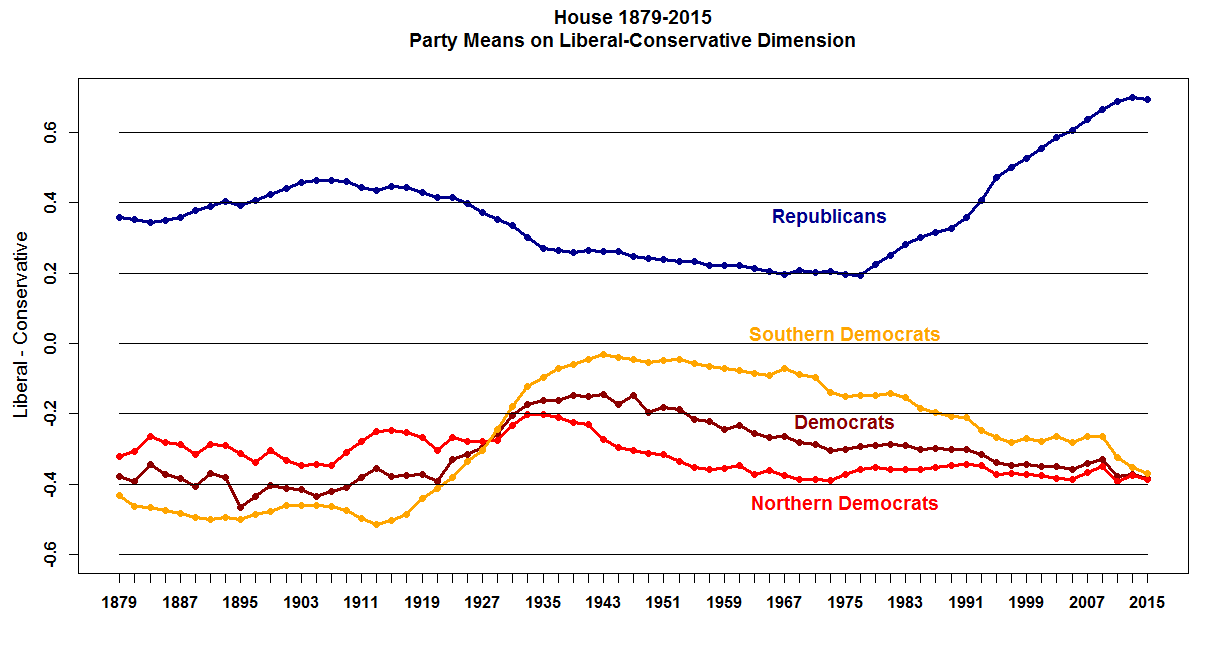
There are a few big takeaways: Democrat and Republicans became less divided between the two world wars, but Republican representatives have become dramatically more conservative after Watergate. (VoteView published a chart for the Senate as well, but it’s almost identical.)
This chart is for Congress, not the general population. It’s a political party thing, not a change in America.
Here’s a fun quote from the NYT article:
In 1960, just 5 percent of Republicans and 4 percent of Democrats said they would be unhappy if a son or daughter married someone from the other party. In a YouGov survey from 2008 that posed a similar question, 27 percent of Republicans and 20 percent of Democrats said they’d be “somewhat” or “very upset” by that prospect. By 2010, that share had jumped to half of Republicans and a third of Democrats.
“Not my daughter!” But with Republicans measurably more afraid.
And then the NYT article does that weird ethical flinch that mainstream news sources do so often:
Political scientists suspect that attack ads, which have grown in number and nastiness, have played a role. And the rise of partisan media has amplified the rhetoric of campaigns, providing confirmation of our worst stereotypes about each other.
Wait. “They all do it”? The NYT is describing a moral equivalence? Not according to their source. Go to the link at Journalists’ Resource, and you get paragraphs like this:
The 2016 presidential election already has become a nasty one, however. A September 2016 report from the Wesleyan Media Project shows that 53 percent of ads that aired over the previous month were negative — compared to 48 percent of ads that ran during a comparable period of the 2012 campaign. The report notes that Hillary Clinton and Donald Trump have taken different approaches with their advertising: “Just over 60 percent of Clinton’s ads have attacked Trump while 31 percent have been positive, focusing on Clinton. Trump, on the other hand, has by and large used contrast ads, which both promote himself and attack Clinton. He has aired no positive ads.”
So it was remarkably one-sided. Funny thing to have missed.
And that’s been the theme for political coverage since Watergate. When Republicans began shrieking that the press were unfair, they managed to muzzle any objectivity to an amazing degree.
No, opinions are not divided on the data. Republicans hack through the social compact with a hatchet, then point at Democrats. Newspapers repeat their words without context or followup. Next up, an inspiring story….
Yes. I’m saying that Republicans have been acting against the country for decades. I’m saying they are instrumental in the coarsening of American discourse. And I’m saying that they are damaging the nation in essential and possibly existential ways.