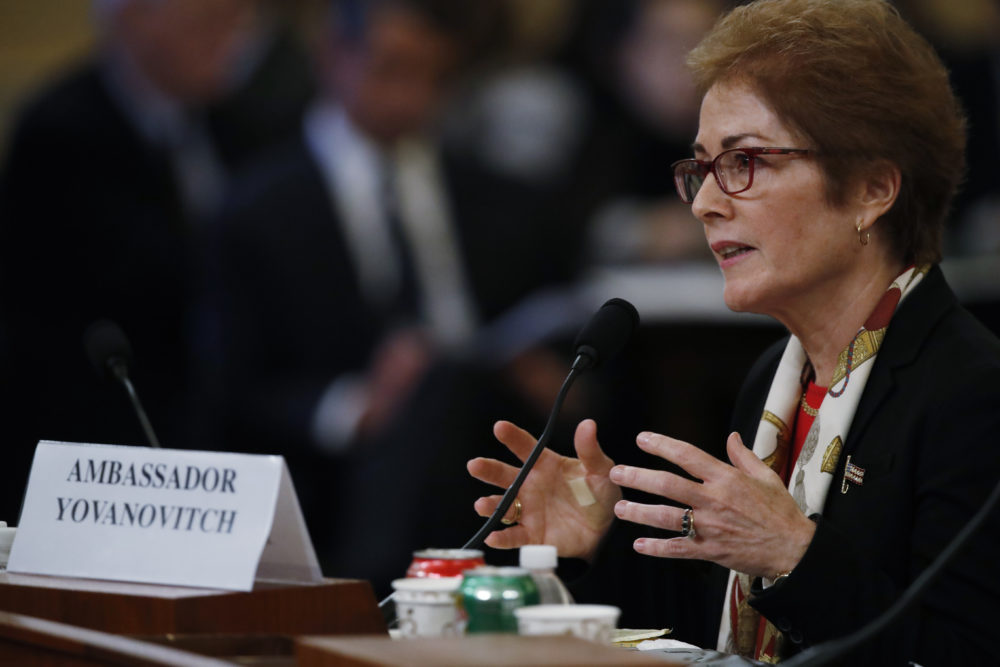
Ever been asked: “How did that make you feel?” I heard that question a half-dozen times or more during the House Intelligence Committee hearing with Ambassador Maria Yovanovitch. It allowed her to talk about the emotional toll of everything from Rudi Giuliani’s smear campaign to President Donald Trump’s threats. And, I admit, hearing the Ambassador’s reaction to Trump’s real-time witness intimidation was critical.
I think there are sexual differences in how we look at questions about our inner emotional landscape. I’m a guy, and I admit, I see the subject as an odd intrusion. I have feelings, sure, and I share them now and then. When I choose. And honestly, people don’t usually pry about it. When they do, though, it feels intrusive. Do they assume I don’t know my mind and need prodding? Is it a demand for information I’m not volunteering? I’m put off by the presumption I owe them that stuff. And the form of the question can be weirdly passive. Not “How do you feel about that.” No. “How does that make you feel?” Oddly passive. “Explain how that external event you can’t control leaves you feeling helpless?” Anyway, that’s guy stuff.
Obviously, I can’t speak to how women see this kind of probing. Are questions about your inner emotional landscape comforting? I can see where someone asking about your feelings can create a non-judgmental space for you to talk. I don’t see that in the question, but I can see if it helps. Is the induced confession cathartic? Is it an introduction to a bonding tradition? I can see that, too. The question doesn’t resonate that way with me, but then I’m a guy.
Here’s the funny part. I can’t remember anyone asking Ambassador William Taylor what he felt. What he heard, what he’d seen, and his level of confidence it what he thought. Maybe they didn’t care as much about his feelings. Did anyone ask George Kent how Trump’s betrayal of Ukraine how he felt? Not that I remember. That seems… unequal? Maybe they’re just assuming guys have no feelings. Either way, both the Democrats and the Republicans decided they didn’t want to hear about that part of their diplomatic experiences.
And yet both Democrats and Republicans House leaders, Intelligence Committee members, and both party counsel repeatedly asked Ambassador Yovanovitch how those events around her made her feel. That seems odd. Did they intend to cast this long-term, plain-spoken, and dedicated professional as a helpless damsel?
Now, here’s where I go all fuzzy. Think about when Ambassador Yovanovitch’s emotional response to President Trump’s veiled threat (in the Sept. 24th call between Trump and Ukrainian President Zelensky). It was a powerful moment. She was afraid and intimidated. She despaired, at least briefly, and felt the harm of his words. It took courage for her to continue. Trump’s words mattered to her, and to us.
And then, when Trump threatened the Ambassador in a Tweet during the hearing, Chairman Adam Schiff’s forceful repudiation had two sides. Yes, I approved Schiff’s opposition to Trump’s blatant tampering. The facts matter. But Schiff’s emotional reassurance was its own powerful moment. We need to address the psychological impact, too.
So, where to go next? I still think the hearings have been a showcase of outdated habits and sexual assumptions. But ‘equality’ shouldn’t be just to choose the male perspective. I think we should take the best of all of us. I wish I had the stamina and the emotional courage that Ambassador Yovanovitch showed on Friday. Even if she didn’t really want to speak at that level, we’re much better informed because she did.