

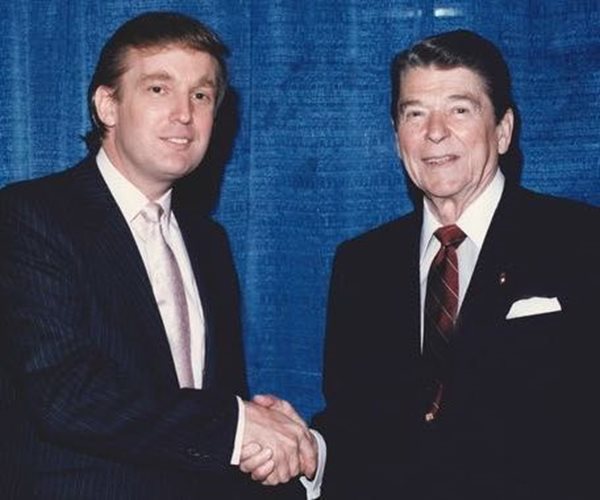
 President Donald Trump’s first year in office reminds me of President Ronald Reagan’s two terms. When Reagan was first elected President in 1981, ultra-conservatives and the religious right reveled in the “return to moral values” for America. The Moral Majority and Baptist minister Jerry Falwell rose to their political peaks.
And the GOP’s big new idea was Supply-Side Economics.
Tax Reform
Like Trump, the Reagan administration promised to overhaul the tax code. And the Republican party did. But the economic experiment of “Supply-Side Economics” failed it’s mission, despite massive pundit efforts to re-write history [1] [2] [3] [4]. National debt doubled from $1 trillion to $2 trillion in debt by 1988, and recovery from earlier recessions relied heavily on demand-side spending on defense.
So much for Reagan shrinking government spending.
Trump also promised a major tax cut during the campaign of 2016. The GOP version just passed the House. Despite revisions, this bill provides significant tax cuts to the wealthiest tax bracket and corporations. What about a middle-class tax cut? Sorry, somebody’s got to pay for this. Taxpayers in New York and New Jersey better prepare to get double-taxed on state and local taxes.
The non-partisan Congressional Budget Office (CBO) estimates the current GOP plan will cause a $1.5 trillion deficit increase over the next 8 or so years, a far cry from the deficit-neutral approach of Reagan’s 1986 Tax Reform Act. How can tax breaks to corporations and the wealthy combined with reduced or gutted regulation and increasing deficits possibly result in economic growth?
The GOP relies on Supply-Side Economics. Yes, you heard that right, but the GOP won’t say it out loud.
Voodoo Economics
What is Supply-Side Economics? Fiscal policies designed to spur economic growth through supply stimulus, mainly by consumer and corporate tax breaks. Add structural changes like reduced or eliminated corporate regulations. To reduce pressure on budget deficits, reduce government spending.
IN SHORT: Supply-Side Economics relies on the idea that lower corporate taxes, and thereby higher profit margins, will stimulate job growth.
Unfortunately, people run companies, and CEOs (who are people, I guess) are far more incentivized toward personal wealth than job growth. CEO incentive packages focus on increasing short-term stock prices and short-run profits

A fast and effective way to quickly jigger profits is to CUT JOBS. That drops costs almost immediately. Short-term, you’ve improved the corporate balance sheets by bumping up EARNINGS (known as EBITDA, which is earnings before write-offs). Stock market analysts see the EBITDA change and cheer! Stock prices rise. People will say you’re doing a great job. And, guess what? You might negotiate a better pay package for yourself. There are reasons CEO compensation is at an all-time high.
Does that sound a lot like our current corporate climate?

Don’t give money to rich people or corporations and expect them to change their spending habits or business practices. That is, unless your idea of ‘success’ means increased donations to your political campaign. If so, then go ahead and pillage when ready.
Valid Economics
I close with an idea. Perhaps tax INCENTIVES might work to stimulate job growth? Like tax breaks for companies that locate in labor-heavy but job-poor regions? Add to that, tax subsidies and grants for job training programs, junior colleges, a freaking high school with a decent SHOP PROGRAM? Or a decent TECH TRAINING program? Remember those, before they were DROPPED to cut costs?
It’s not that hard to incentivize growth. But our government policy-makers pander to environmentally challenged industries and large corporate interests, who pay MASSIVELY for regulators to look the other way. Corporations focus on short-term gains; it’s how they’re built. Letting them rule our government policy machine hijacks rational economic policies. Corporations want higher short-term profits, not long-term job growth or decent wages.
I don’t see that changing any time soon. Not while industries with large lobbyist budgets and deep pockets effectively control the current Political Economy and the politicians they help get elected. If you’re a big corporation, buying a politician is cheap and irresistibly cost-effective.

Maybe the next nut-ball we elect President will be less con-man, bring fewer swamp residents, and build a CONSENSUS with the electorate and not just a cardboard cutout of change that covers up the same-old corporate pandering.
And click that last link to understand it’s meaning in this context.
